


You have probably heard the expression “a leopard can’t change his spots.” We use it in referring to a person not being able to change his innate nature, especially bad character traits. He may pretend to change, but he’s just covering up his real nature. He may try very hard to change, but willpower only takes him so far before his true self resurfaces. Then we shake our head and say, “Well, a leopard can’t change his spots.” In other words…he’ll never change.
Did you know this expression originally comes from the Bible? The words were spoken by Jeremiah to the people of Judah, the southern kingdom of divided Israel. God had called Jeremiah to be a prophet to these stubbornly unrepentant people.
Under evil kings, the people had disregarded God’s teachings. They worshiped false gods, even sacrificing their children to them. When Josiah came to the throne, he sought God and called the entire nation to repentance. They displayed appropriate outward behaviors but, unlike Josiah, it was not true repentance. “Judah did not return to me with all her heart, but only in pretense,” declares the Lord (Jeremiah 3:10). After Josiah died, the people returned to their idolatry.

For 40 years, Jeremiah’s ministry was to call the people of Judah to repentance, but they refused to listen. Instead, they sought pagan nations as allies and would not turn to God. It was during this time that Jeremiah asked the question: “Can the Ethiopian change his skin or the leopard its spots?” (Jeremiah 13:23).

The question was rhetorical because the answer was obvious to the listeners. Of course, the Ethiopian cannot naturally change the color of his skin, nor can any man. It is determined by his God-given DNA. It’s the same for the leopard. “Every leopard sports a pattern of rosettes and whisker spots as unique to that individual as a set of human fingerprints.” [1] There is absolutely nothing the leopard can do to change that pattern. The blueprint is written in its genes.
I wonder if Jeremiah was shaking his head when he followed his question with this declaration: “Neither can you do good who are accustomed to doing evil” (Jeremiah 13:23). He saw that rejecting God’s ways had become so ingrained in them that their ability to do good had become as impossible as the leopard changing his spots. They had lost all desire to change, and they no longer feared any consequences. Even the threat of captivity could not change their hearts.
The situation sounds hopeless. But God does not leave us without hope. Even though man cannot change himself, Luke said, “nothing is impossible with God” (Luke 1:37). Paul said, “if anyone is in Christ, he is a new creation; the old has gone, the new has come!” (2 Corinthians 5:17).
Perhaps Jeremiah’s metaphor was two-fold in order to give a complete picture of sin. Could the Ethiopian’s skin represent the totality of the sin nature we are born with and the leopard’s spots represent the sinful habits we struggle with? We can’t change either one, but God can. And he will.
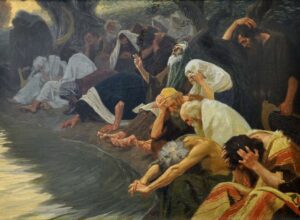
The exile Jeremiah prophesied came upon the Israelites; they were taken away to Babylon. One day Jeremiah and the Lord were having a conversation. God said to Jeremiah, “5I regard as good the exiles from Judah, whom I sent away from this place to the land of the Babylonians. 6My eyes will watch over them for their good, and I will bring them back to this land. I will build them up and not tear them down; I will plant them and not uproot them. 7I will give them a heart to know me, that I am the Lord. They will be my people, and I will be their God, for they will return to me with all their heart” (Jeremiah 24:5-7).
It was God himself who sent his people into exile. He didn’t abandon them, though. He watched over them until the time came for him to bring them back to the land he’d given them. He gave them a new heart, a heart that hungered to know him. He could do this now that they had returned to him wholeheartedly—which didn’t happen until they were exiled. God totally knew what he was doing! He always does.

No, a leopard can’t change his spots. And neither can we change our sinful nature. Perhaps knowing the background of this expression will remind us that God can change a seeking heart. And even if we aren’t looking for change, he loves us so much that he orchestrates the circumstances of our lives to change our desires.
Scripture quotations are from NIV.
Feature photo by High Tea With Elephants on Unsplash


Angie Camp
June 10, 2025I did not know those spots were called whisker spots!
I did not know “can a leopard change his spots” was from the Bible!
“My eyes will watch over them for their good.” What a blessed assurance!
“He orchestrates the circumstances of our lives” to change us…how true.
By the way, I love cats of all sizes! Angie
Bonnie
June 10, 2025I know you love cats, Angie! Those big ones sure are beautiful, but you couldn’t cuddle with them.
I love that scripture about God “watching over them for their good” after he sent the Israelites into exile. It is so comforting to know that God is always concerned for our good.
Thanks, Angie.
Brenda+Murphy
June 10, 2025Ooh, that’s really good. We can’t conceive of a God that is that loving and good. This line really struck me: “My eyes will watch over them for their good…” Wow, what a stunningly loving God! ❤️
Bonnie
June 10, 2025Well said, Brenda! Thank you for your thoughts.