

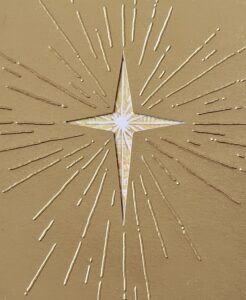
For many years, we had the perfect star adorning our porch gable for Christmas. It was made of shimmering gold material. It was a Bethlehem Star, having elongated top and bottom points. Its size was proportional to the space it occupied.
Then one year the lights in the star didn’t work. It was virtually unfixable since it couldn’t be taken apart. We couldn’t find another just like it. Somehow CW managed to stuff some lights inside, and it limped along for another couple of years. Finally, it deteriorated beyond use.
I spent hours searching online for a replacement. It had to be the same shimmering material. Whenever I located one, it was silver (had to be gold), too small (would look puny), too large (would look overpowering in the space), or not the right shape (had to be a Bethlehem Star). I eventually gave up on ever finding another perfect star. Our gable was dark for two years.

But recently while CW was wandering the aisles of Lowe’s, a star caught his eye. It was the right material! It was gold!! It was the right shape!!!…But it was 3’ tall. Oh my. We’ve been starless for so long, though, that we overlooked the size of it. He brought the display model home, the only one left. It just barely fits in its new home, but our Christmas Star is back!
The star in the biblical narrative is perhaps an overlooked “character” in the nativity cast. But the story can’t be told without it. It was not called the Christmas Star or the Star of Bethlehem as we name it today. The Magi refer to it only as his star.
“1After Jesus was born in Bethlehem in Judea, during the time of King Herod, Magi from the east came to Jerusalem 2and asked, ‘Where is the one who has been born king of the Jews? We saw his star in the east and have come to worship him’” (Matthew 2:1-2).
That star must have been spectacular, if for no other reason than it was the star of the newborn king of the Jews. The star of the Messiah!
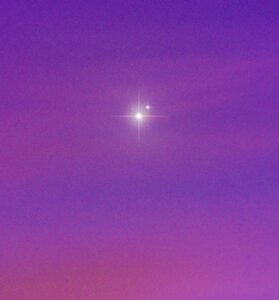
Was it actually a star? Or was that just a figurative term because it was a bright light in the sky? Many different theories exist concerning what it was: a supernova, a comet, a meteor, or the conjunction of planets? There’s even the suggestion that the Magi were seeing the “glory of the Lord” that “shone around” the shepherds (Luke 2:9) when they received the announcement of the birth of the Savior.
Whatever it was, it was a bright light in the sky over the land of Judea, and the Magi saw it from possibly thousands of miles away.
The Magi’s history reaches back hundreds of years before the appearance of the star. The Magi was “a priestly class among the Medes and Persians” and “the term came to describe specialists in astronomy, dream-interpretation, and sacred writings.” [1] Kings had long sought advice from these councils of wise men.
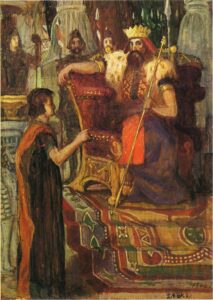
Babylon “perfected a council of advisors.” [2] When Babylon captured Judah, Daniel was one of the young Israelite captives. Because of Daniel’s wisdom and understanding, King Nebuchadnezzar made him one of his trusted wise men. But Daniel was different than the other wise men; his wisdom came from God. When the king came to see that Danel’s God was supreme, “He made him ruler over the entire province of Babylon and placed him in charge of all its wise men” (Daniel 2:48).
As chief of the Magi, “Daniel wrote about his activities and the prophecies he received…These writings, along with the prophecies of Isaiah and other Scriptures, would be added to the Magi’s library of ancient writings. Under Daniel’s guidance, the Magi were more than mere practitioners of the occult. They became devoted seekers of truth.” [2]
After the Israelites returned to their own land, they increased in such numbers that they “dispersed over Asia, Africa, and many parts of Europe,” spreading their expectation of the promised Messiah. [3]
It is the belief of many scholars that the Magi who saw the star “came from the area of ancient Babylon and Persia (under Parthian control when Christ was born).” [4] With their knowledge of the ancient writings, astronomy, and the Jewish belief in the coming of the Messiah, they could conjecture that the star signified the long-awaited fulfillment of the prophecy. [3]

After all, they knew the sky, and this light was something they’d never seen before. It was also hanging over Judah, where they’d expect the king of the Jews to be born. So they set off in its direction to find the newborn king of the Jews and worship him.
When they arrived in Judah, they went to Jerusalem, the seat of government for Israel, to inquire of the king where the king of the Jews was. He sent them to Bethlehem. Bethlehem might have been a “little town,” but how would they find one particular child? They were ecstatic when the same star they’d seen from home reappeared and led them to the exact place where the child was.
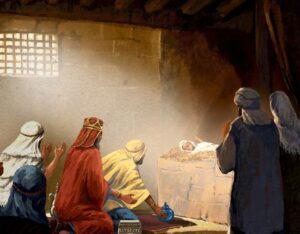
“9After they had heard the king, they went on their way, and the star they had seen in the east went ahead of them until it stopped over the place where the child was. 10When they saw the star, they were overjoyed. 11On coming to the house, they saw the child with his mother Mary, and they bowed down and worshiped him…” (Matthew 2:9-11).
We never read again about that star. It appeared, did its job, and left, but it had much more than a bit part in the story. Here are three roles it performed.
The star announced the fulfillment of God’s promise to send the Messiah. During the time of Moses, Balaam prophesied his coming. “I see him, but not now; I behold him, but not near. A star will come out of Jacob; a scepter will rise out of Israel” (Numbers 24:17). The star’s appearance signified that the splendorous king, the ruler who would come out of Israel, had indeed come!
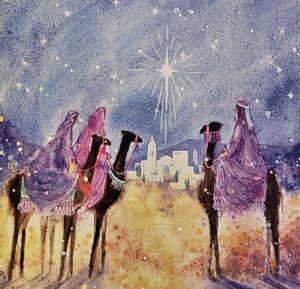
The star guided the Magi to the Messiah. It first pointed them in the proper direction. That was what they needed to begin their journey. When they reached the general area, it completed the job by leading them to the precise location of Jesus. It left them with no doubt they had found the king they had come to worship.
The star gave hope to all people. It led the way to Jesus, who is our hope (1 Timothy 1:1), the Savior who makes possible our relationship with God. It’s interesting that the star did not appear to a devoted Jewish family who arose every morning with anticipation that this could be the day their beloved Messiah would come. Instead, it appeared to gentiles, who may have come from the very area in which the people of God had been held captive. The star made it clear that this Savior was for everyone.
The Christmas Star has not been seen since the birth of Christ. (As big and bright as it is, our porch gable star doesn’t count!) His star was singular and unique. Whatever it was physically, I believe it was the presence of Father God proclaiming his Son’s earthly birth and showing the way to Jesus in order to reveal the way to himself.
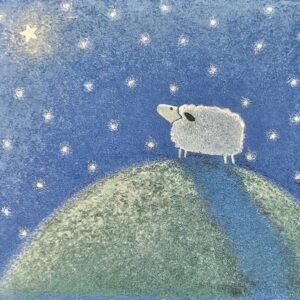
He is still doing that today. We just need to find our star, God’s personal way of appearing to and guiding each of us.
And then follow.
If we only look from afar—oh, what we’ll be missing!
[1] Topical Lexicon
[2] “Who Were the Magi in the Christmas Story?”
[3] Benson Commentary
Scripture quotations are from NIV.
Commentary notes are from Bible Hub. See Resources.
Feature image by Angeles Balaguer from Pixabay




Brenda+Murphy
December 9, 2025I haven’t specifically thought of the star itself (thought I do love stars!), that’s interesting. I particularly liked this, which is a cool insight: “… it appeared to gentiles, who may have come from the very area in which the people of God had been held captive. The star made it clear that this Savior was for everyone.” Wow! This makes me think how the other aspects of the Nativity story, no matter how minor, must hold great meaning because of the whole, incredible meaning of the event.
Bonnie
December 9, 2025I agree, Brenda. I believe there are a great many gems tucked away in the events of the Nativity. I love learning of new (to me) ones.