
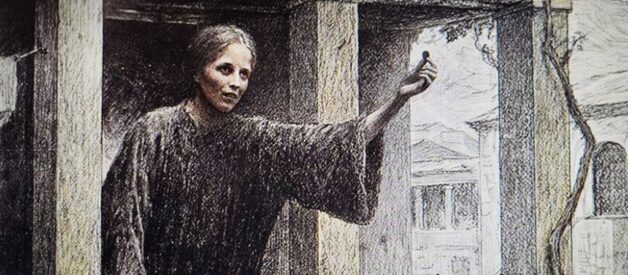

Do you know how much God loves you? He loves you so much that he continually seeks you, even when you don’t know you’re lost. Jesus illustrated this in a parable about a woman who lost a coin:
“8Or suppose a woman has ten silver coins and loses one. Does she not light a lamp, sweep the house and search carefully until she finds it? 9And when she finds it, she calls her friends and neighbors together and says, ‘Rejoice with me; I have found my lost coin.’ 10In the same way, I tell you, there is rejoicing in the presence of the angels of God over one sinner who repents” (Luke 15:8-10).
Everything in this story speaks of the immense love God has for us.
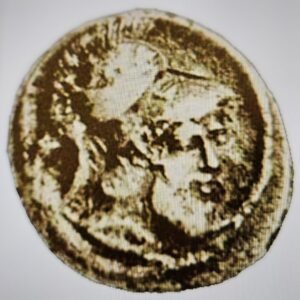
We bear God’s image. Current coins in the first century A.D. bore the image and inscription of the Roman ruler (Matthew 22:19-21). That is what gave them value as currency. Other coins may have been imprinted with something else, giving them a different kind of value.
Every person has value because he bears the image of God. “God created man in his own image…” (Genesis 1:27). God loves every one of us because we were each created to be reflections of his glory.
We have immeasurable worth to the heart of God. The word translated as silver coin is sometimes translated drachma. A drachma was “roughly a day’s wage for a common laborer” and so held only a modest face value. Though one coin could be the difference between surviving and being in need [1], its monetary value was relative. But what if the silver coin in this parable was not currency? What if it possessed an entirely different kind of value for the woman?
Wiersbe writes, “When a Jewish girl married, she began to wear a headband of ten silver coins to signify that she was now a wife. It was the Jewish version of our modern wedding ring, and it would be considered a calamity for her to lose one of those coins.” [2]

Pillai sheds more light on this custom. The coins were a precious gift from the bridegroom passed down from generation to generation. The husband’s family coat of arms was stamped on one side of each coin, the year it was made on the other. They had tremendous sentimental value to his family. If one were to be lost, no amount of money could redeem it. [3]
If the ten silver coins in this story were indeed such a gift, you can see how their value would be greatly magnified to her. They represented her relationship with her husband; losing even one would cause her much distress because her special gift would be incomplete.
God has a multitude of followers. Why would one lost “coin” matter to him? Because he cares deeply about every individual and desires a relationship with every one of his creations. “The Lord is…not wanting anyone to perish, but everyone to come to repentance” (2 Peter 3:9).
We see his same loving heart in the Old Testament. “As surely as I live, declares the Sovereign Lord, I take no pleasure in the death of the wicked, but rather that they turn from their ways and live. Turn! Turn from your evil ways! Why will you die, O house of Israel?” (Ezekiel 33:11). God is heartbroken when even one of his creations is separated from him.
God comes to us in our helplessness. The coin could do absolutely nothing to save itself from being lost. It was at the mercy of the woman to find it and restore it to the place it belonged.
And so it is with us. We are lost and powerless to save ourselves (Romans 5:6). If we could, we wouldn’t need a Savior. Knowing this, God lovingly shines his light on us, lifts us up out of our darkness, and restores us to the place we were always meant to be—with him.
God refuses to give up on us. With her lamp and broom in hand, the woman searched carefully. Here search means to seek until you get to the bottom of a matter. [4] This idea is amplified by the Greek word translated carefully, which occurs in the Bible only in this one verse. “The word expresses a care that refuses distraction until the object is secured.” It spotlights “the unwavering, systematic effort invested in recovering what was lost.” [1]
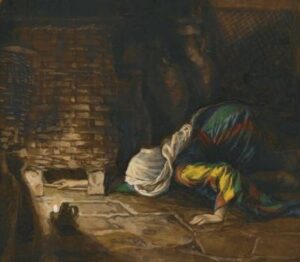
Pillai says if a woman lost one of “the ten pieces of silver,” her husband and his family were disgraced. The Eastern people believed it meant “the withdrawal of God’s favor” from the household. For that reason, if she couldn’t find the coin, she would have to be put out of the house. One of these coins was rarely lost, but if it was, the woman would not give up until she searched every square inch and recovered it. [3]

A few months ago, CW had to remove his wedding ring for a medical procedure. He hadn’t had it off in several years, and it didn’t come off easily. It would not go back on, so he began wearing it on another finger where it was loose. One day, after returning from a bike trip, he noticed his bare finger. We searched in the house, and in another house he’d been in. We searched in his car, his backpack, the gloves he was wearing. We searched up and down the street with a flashlight because he thought he might have heard something drop when he got out of his car. If we knew approximately where it was, we’d still be searching because it has great value to us. But that ring could be anywhere, including along 35 miles of bike trail or concealed in the grassy park he camped in. So we’ve given up looking for it. We know it was only a symbol of our relationship, and a ring can be replaced.
We may give up looking for something that means a lot to us…but God doesn’t. We are not just a symbol of something to him; we are each a unique creation and are irreplaceable to him. He is totally invested in pursuing those who don’t yet know him. That was his mission in coming to earth. He said of himself, “For the Son of Man came to seek and to save what was lost” (Luke 19:10). And we see his constant pursuit of the lost in the Gospel accounts of his life.
God seeks those who don’t even know they are lost. The coin had no idea it was lost. It didn’t know it needed to be found.
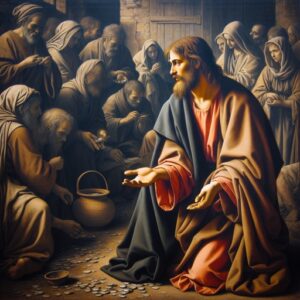
While Jesus was having a meal with tax collectors and sinners who had gathered to hear him, the Pharisees and teachers of the law were “indignantly complaining” [5] about Jesus associating with those people (Luke 15:1-2). Jesus was telling this parable of the lost coin to those Pharisees because he cared about them also. He wanted them to understand their own lostness.
God loves the person who doesn’t know his own condition. The Lord said through Isaiah, “1I revealed myself to those who did not ask for me; I was found by those who did not seek me. To a nation that did not call on my name, I said, ‘Here am I, here am I.’ 2All day long I have held out my hands to an obstinate people, who walk in ways not good, pursuing their own imaginations—” (Isaiah 65:1-2).

God celebrates over every person he “finds.” After finding the coin, the woman was probably relieved, weary, and possibly embarrassed over losing something so valuable. But her exultation would have eclipsed all other emotions for “she had been saved from being an outcast.” Her dire situation would have been a concern to the whole community; she had to celebrate the coin’s recovery with them. [3]
In the same way, God rejoices over every single lost person who is found because he doesn’t want any of us to remain outcasts. His heart’s desire has been fulfilled. Another child has been placed into the family he was created for. And God bursts with joy, celebrating with his angels.
We are all lost coins to begin with. If you have already been found by Jesus, you have been returned to the place you belong. You are now living in the blessing of relationship with him. You are a part of his bride and have the hope of being in a forever union with him.
And if you haven’t yet been found, know that he is still pursuing you relentlessly. All day long he is holding out his hands to you.
That’s how much God loves you!
Scripture quotations are from NIV.
Greek definitions are from Bible Hub. See Resources.
[1] Topical Lexicon
[2] Wiersbe, Warren. (1989). The Bible Exposition Commentary: New Testament (Vol., p.234).
[3] Pillai, Bishop K. C. (2015). Eastern Customs and Idioms of the Bible (p. 81-82,270-271).
[4] HELPS Word-studies
[5] Thayer’s Greek Lexicon
Feature image – “The Lost Coin” by Eugene Burnand





Brenda+Murphy
February 10, 2026That was so interesting!!!! I’ve never heard that interpretation before but it makes so much sense. The story we usually get from this parable is a good one but this realization makes it come alive, makes it mean so much more than the surface story we’re taught. I love that it relates to her marriage and how precious that is to her. Thanks for these insights. 🙂
Bonnie
February 10, 2026Yes, I loved discovering this! It made so much sense to me, too, Brenda. Why was the woman so intent on finding that coin? Though I couldn’t find my way back to actual primary sources, everything I read came together to solidify this idea for me.
marilyn
February 10, 2026Bonnie,
This is just so beautiful! Thank you for taking the time to do an in-depth study of this precious parable and the truth of it. I was truly blessed by it.
Marilyn
Bonnie
February 10, 2026You’re welcome, Marilyn. I love finding out about the customs of that time and place. It can really change our understanding. What I’m learning is that we read the Bible through our Western mindset, but it all took place in the Eastern culture that is so different than ours.