
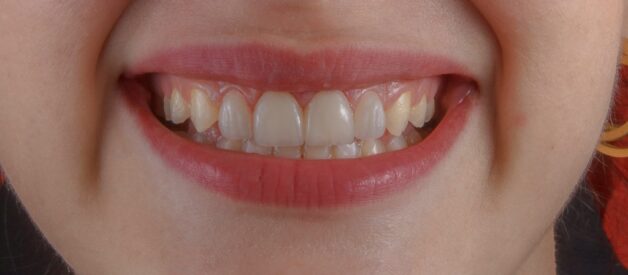

Have you ever done anything “by the skin of your teeth”? Maybe you were walking across the street and a speeding car rounded the corner barely missing you. A couple more inches and…well, let’s just say you reached the curb by the skin of your teeth. Or perhaps you almost didn’t pass your road test to get your driver’s license. One more neglected turn signal would have dropped you below the required 80% score. But by the skin of your teeth, you were able to celebrate by driving your friends to the nearest DQ for ice cream. Whether narrowly escaping danger or barely achieving a desired outcome, we use the phrase to mean the very thinnest of margins.
Did you know this expression originated in the Bible? It is found in Job 19:20. Job said, “I have escaped with only the skin of my teeth.”
You may have noticed it is worded slightly different from our modern idiom. Job said “with only the skin of my teeth.” Some Bible versions do translate it as by, but the earliest biblical evidence of the phrase is from the Geneva Bible in the 1550s. [1] The literal translation of the Hebrew text is “My bone cleaueth to my skinne and to my flesh, and I haue escaped with the skinne of my tethe.” The 1611 King James Version also uses with. [2] So our expression may not have the exact meaning as the words Job spoke.
Before we look into Job’s meaning, though, you may be wondering what teeth skin even is. I will share some things I found. However, you’ll probably still be scratching your head afterward.
One idea is that the skin of the teeth refers to the enamel. The outer layer of the teeth does serve as protection from bacteria penetrating and causing cavities similar to the skin protecting the body from disease, but enamel has never been called skin. Other commentators have said it means the lips.

The majority of the commentators I read, though, believe it to mean the gums, even though technically gums are also not skin. In fact, one source emphasized that “the gum is not skin, and can therefore not be called ‘skin of teeth’ in any language.” [3] However, in one lexicon the definition given for the Hebrew word or translated as skin in this phrase is gums. [4] So perhaps we shouldn’t try to interpret the words literally. Maybe it was a proverbial phrase like our idiom is.
Now let’s look at what Job meant by “escaping with the skin of his teeth.” First we need to know his situation. In one day, he had lost all his flocks to theft and fire, most of his servants had been killed, and all of his children had died when a windstorm caused a house to collapse on them. On another day, he was afflicted with painful sores all over his body. He mourned to his friends, “My body is clothed with worms and scabs, my skin is broken and festering” (Job 7:5).
Some theologians go with the literal interpretation saying that with sores covering all Job’s body, the only place without sores was his gums. A similar thought is that the disease had caused his teeth to fall out and he was left with only his gums.
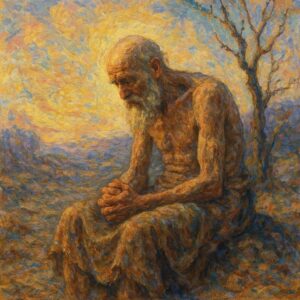
Then there’s the proverbial thought. Some believe it means Job barely escaped death, closely aligning with our modern phrase. Yet many other scholars do not think it has anything to do with avoiding hazards. Rather, they believe Job is saying that he is left with barely anything. He has lost his wealth, servants, children, and health. His other relatives have abandoned him, his friends detest him, and children ridicule him (Job 19:13-19). What he escaped with amounted to nothing at all.
John Hartley, an Old Testament scholar, says “The explanations for the metaphor are multiple and unconvincing. Its meaning eludes us.” [5] Though we may not know with absolute certainty the original Hebrew meaning, it’s likely that it has changed through time to arrive at our present usage. Both expressions, however, seem to refer to very little of something, whether you barely have anything left or you barely escape or succeed.
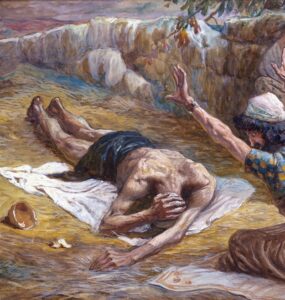
As I pondered Job’s use of this phrase, I realized that it revealed a difference between Job’s perspective and God’s. As Job sat in ashes, scraping at his sores with pieces of broken pottery (Job 2:8), he was suffocating in his pain and loss. At that moment he couldn’t see anything beyond his misery. In fact, he “cursed the day of his birth” (Job 3:1).
God, however, saw a bigger picture. He knew what he was doing in Job’s life right then and what was yet to come. After God and Job had a heart-to-heart talk, God doubly restored his material possessions. He also gave him more children. Job lived to see “his children and their children to the fourth generation” (Job 42:16). “The Lord blessed the latter part of Job’s life more than the first” (Job 42:12).

“With only the skin of my teeth” reflected Job’s perspective, not God’s. After God straightened Job out on a few things—and before the restoration—Job’s perspective shifted. He told God, “I know that you can do all things; no plan of yours can be thwarted…Surely I spoke of things I did not understand, things too wonderful for me to know” (Job 42:2-3).
When we use our modern expression, might we also be revealing a narrow perspective? Though we think we barely made it—whatever it is—God may see it another way. It could all be part of his well-thought-out plan for us.
And although we may not understand the plan, we can always and completely trust in its author.
Feature photo by Ozkan Guner on Unsplash
[1] Etymonline.com
[2] Wordorigins.org
[3] Keil and Delitzsch Biblical Commentary on the Old Testament
[4] Brown-Driver-Briggs Hebrew and English Lexicon
[5] Challis.com
Scripture quotations are from NIV.
Hebrew definition and commentary notes are from Bible Hub. See Resources.




Irene
March 10, 2026What great insight into a difficult passage, Bonnie. Job’s perspective vs God’s. A good reminder.
Bonnie
March 10, 2026Thank you, Irene. So good to hear from you.
Brenda+Murphy
March 10, 2026Oh, we can always use a reminder that God’s perspective isn’t the same as ours. And what an interesting look behind that verse, and we still don’t know! We’ve got the gist of it though, lol. Who would have thought we’d find that idiom in the Bible!
Bonnie
March 10, 2026Oh my. I always want to know what things mean, but I just wasn’t finding anything solid here. I’m so grateful that we don’t have to have total understanding of a passage in order for God to speak His truth into our lives.
Thanks, Brenda!